Middle Innovation Trap
이정동, Chulwoo Baek, Sira Maliphol, Jung-In Yeon (2019) · Foresight and STI Governance 13(1):6–18 · DOI ↗
“Middle income trap” 의 본질을 기술 역량 전환 의 실패로 재정의한다. 신흥국 발전의 두 capability — 실행 역량 (외부 design 을 물리 구현, manual-based, learning-by-doing) 와 설계 역량 (concept 정의, tacit, learning-by-building, trial-and-error) — 중 후자로 전환이 자동이 아니라 소수 국가만 성공 한다는 관찰에서 “middle innovation trap” 또는 “capability transition trap” 으로 reframing. 한국·중국 사례로 trial-and-error 의 시간·공간·정책 차원 축적 패턴을 제시하고, innovation-commons + design capability 4 기둥 (advanced manufacturing base, strong learning capability, cultural appreciation of trial and error, consistent innovation policy) 을 정책 처방으로 제시. 기술경영경제정책전공 의 capability-transition 라인의 conceptual flagship.
- RQ: 왜 대부분의 중소득국이 high-income 으로 transition 못 하는가? Middle income trap 의 source 는 기술 역량의 어떤 구조적 한계이고, 어떻게 극복하는가?
- 방법론: 문헌 리뷰 (evolutionary economics + innovation systems 종합), 사례연구 (한국·중국·일본 등 latecomer 사례 비교)
- 데이터: 자체 empirical 데이터 없음. World Bank (2012) 의 101 중소득국 중 13 국만 high-income 진입 통계 등 secondary stylized facts
- 주요 발견: middle income trap = implementation → design capability transition 의 실패. 두 capability 는 4 dimension 에서 본질적으로 다름 (knowledge form: explicit/tacit; nurture: learning-by-doing/learning-by-building; performance: efficiency/uniqueness; cost: low/high). Design capability 축적은 trial-and-error 시간·자원 투입을 요구하며, 한국 1980-2000 년대의 chaebol R&D 집중·국가 산업정책 일관성이 그 사례
- 시사점: 정책 처방 4 기둥 — (i) advanced manufacturing base, (ii) strong learning capability, (iii) cultural appreciation of trial and error (failure tolerance), (iv) consistent innovation policy. innovation-commons 으로 trial-and-error 비용을 공유하는 제도 설계가 핵심
요약
World Bank (2012) 분석에 따르면 1960 년대 lower-middle income 진입한 101 개국 중 high-income 진입한 국가는 단 13. 이 압도적 불균형의 standard 설명은 Lewis-type 발전모델 — 저생산성 농업에서 고생산성 제조업으로 노동 이동 + 외부 기술 codified 채택으로 catching-up 가능. 그러나 중소득 도달 후엔 latecomer’s advantage 소멸 + 저임금 신흥국 + 선진국 기술 따라잡기 어려움이 동시 작용해 성장 둔화. 이 설명은 함정의 경로 는 설명하지만 탈출 방법은 답하지 못한다. 본 paper 의 conceptual move 는: 함정의 본질을 두 기술 역량 type 사이의 transition 실패 로 재정의하는 것.
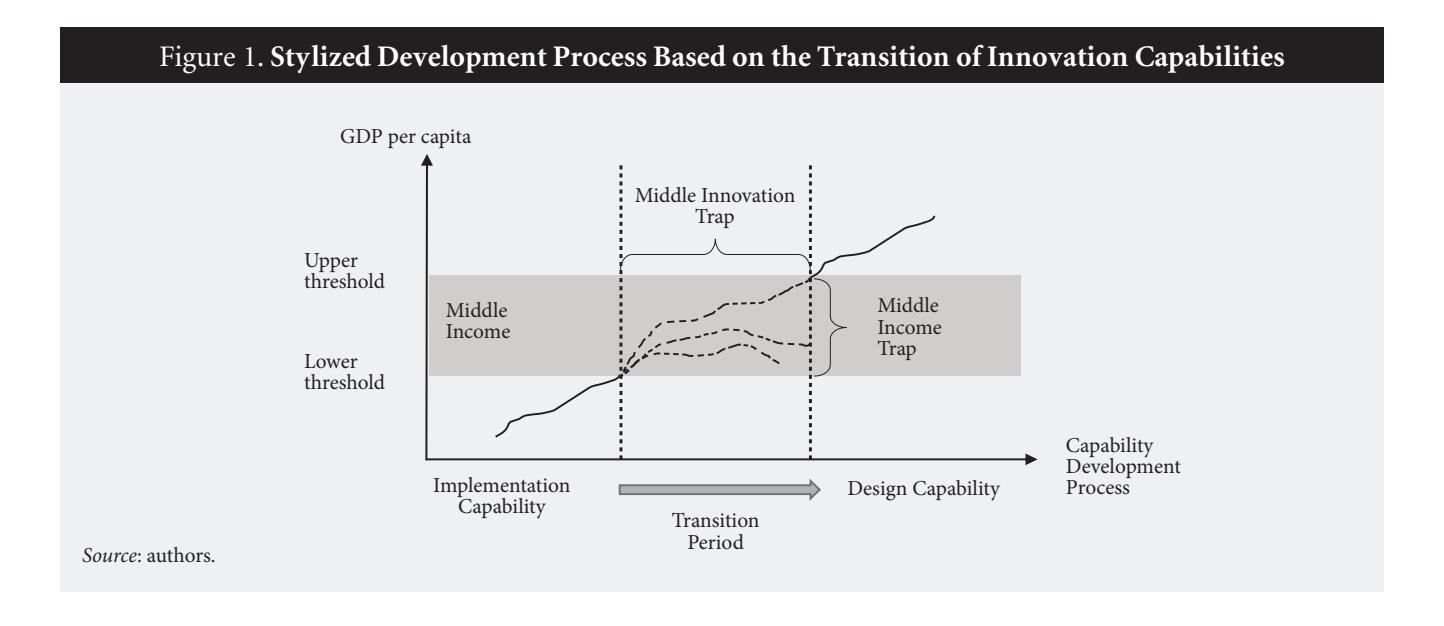
핵심 구분 — 실행 역량 는 주어진 concept design 을 물리 구현하는 능력으로 manual 같은 explicit knowledge 에 의존, 효율·속도가 performance criterion, learning-by-doing 으로 반복 실행이 누적 (Bell-Pavitt 1993, Zollo-Winter 2002). 설계 역량 는 새로운 concept 을 정의하는 능력으로 tacit knowledge 와 organizational memory 에 의존, uniqueness 가 performance criterion, learning-by-building 의 trial-and-error 가 누적. Toyota JIT 는 design (Toyota 가 concept 생성, 다른 자동차 회사가 implementation) 의 전형 예. 두 capability 의 발전 시퀀스 가 곧 경제 발전 stage 와 대응 — implementation 축적 → middle lower threshold, implementation+design 동시 진행 → middle upper, design dominant → high-income. 따라서 middle income trap = “capability transition trap” = “middle innovation trap” 이라는 reframing.
본 paper 의 정책 함의는 design capability 축적의 제도적 조건 으로 좁혀진다. Trial-and-error 비용을 단일 행위자가 부담하기엔 너무 크므로 innovation-commons (공동 trial 공간·자원 풀) 가 필요하고, sociocultural 차원에서 failure 의 cultural appreciation, 정책 차원에서 일관성 (실패에도 policy abandonment 하지 않는 인내) 이 결정적. 한국·중국 사례에서 chaebol R&D · 정부 산업정책의 시간적 일관성 과 공간적 cluster 가 capability transition 의 가능한 경로로 제시. 한계는 — conceptual paper 라 4 pillar 가설의 cross-country quantitative test 가 부재; 같은 Foresight and STI Governance 13(1) 특집호의 sibling paper 들이 보완 작업을 담당한다.
핵심 결과
본 paper 는 conceptual 이라 핵심 결과는 프레임워크 자체 다.
Implementation vs Design Capability 비교 (Table 1)
| 차원 | Implementation capability | Concept design capability |
|---|---|---|
| Knowledge 형태 | explicit (manual, codified) | tacit (organizational memory) |
| 양성 전략 | learning-by-doing, 반복 실행 누적 | learning-by-building, trial-and-error 누적 |
| Performance 기준 | speed, cost efficiency | uniqueness, novelty |
| 학습 곡선·비용 | 낮음, 단기 가능 | 높음, 장기 누적 필요 |
경제 발전 stage 와 capability 의 대응 (Figure 1 의 narrative)
| Stage | Dominant capability | 임계 |
|---|---|---|
| Low-income | 농업·단순 제조, capability 미축적 | — |
| Lower-middle | implementation 축적 (OEM, manual-based) | latecomer’s advantage 활용 |
| Upper-middle | implementation + design 병행 시도 | trap 발생 지점 |
| High-income | design capability dominant | trial-and-error 누적 성공 |
Design capability 의 4 pillar
- Advanced manufacturing base — implementation 강화의 누적이 design 의 기반
- Strong learning capability — trial 결과를 흡수해 다음 trial 로 이전하는 능력
- Cultural appreciation of trial and error — failure tolerance, risk-taking 수용
- Consistent innovation policy — 단기 성과에 정책이 흔들리지 않는 일관성 + innovation-commons 같은 비용 분담 제도
연구 계보
본 paper 는 Bell-Pavitt (1993 Industrial and Corporate Change) 의 implementation knowledge tacit/explicit 구분, Kim L. (1997 Imitation to Innovation) 의 한국 발전 단계 모델, Lall (2000) 의 technological capabilities 전통, Radosevic (1999) 의 international technology transfer, 진화경제학 (Nelson-Winter 1982, Zollo-Winter 2002) 의 capability 누적 framework 을 종합한 conceptual contribution. World Bank (2012), Eichengreen et al. (2013), Gill-Kharas (2007) 의 middle income trap 통계 base 와 Agenor (2017), Vivarelli (2016) 의 capability-based 해석을 잇는다.
author page 분류상 기술경영경제정책전공 capability-transition 라인의 conceptual flagship 에 해당한다. 공저자 Sira Maliphol 의 STI 정책 라인이 같은 시기 sibling 으로 동시 진행됐다.
See also
- 중진국 함정
- 실행 역량
- 설계 역량
- innovation-commons
- capability-transition
- 시행착오
- Local capacity, innovative entrepreneurial places and global connections: an overview
- 이정동
- Sira Maliphol
인접 그래프
- 인물 4
- 개관 1
- 방법론 2
- 개념 5
- 주제 2
- 수록처 1
- 분류 2
- 논문 12
이 문서를 가리키는 페이지
논문 (12)
- A tale of two technological capabilities: economic growth revisited from a technological capability transition perspective
- How Bounded Rationality of Individuals in Social Interactions Impacts Evolutionary Dynamics of Cooperation
- Innovation policy responses to address vulnerabilities of national innovation systems: long-lasting impacts of COVID-19
- Introduction to APPC-2018, a Special Issue of the Journal of Productivity Analysis, 'Novel Applications of Efficiency and Productivity Analyses in the Asia-Pacific Region'
- Local capacity, innovative entrepreneurial places and global connections: an overview
- Mapping the Evolutionary Pattern of Mobile Products: A Phylogenetic Approach
- Research and development linkages in a national innovation system: Factors affecting success and failure in Korea
- Revisiting South Korean industrial development and innovation policies: from implementation capability to design capability
- Southeast Asian Catch-up Through the Convergence of Trade Structures
- Techno-nationalism to collaborative technology sovereignty
- The co-evolution of production and technological capabilities during industrial development
- The industrial and technology policies of Korea from the perspective of design principles